Verity AI Underwriting Assistant
Developing a new AI feature for a B2B lender dashboard.
Year:
2026
Timeframe:
4 weeks
Tools:
Figma Suite, Claude Suite
Category:
AI, B2B

01 • Overview
Context
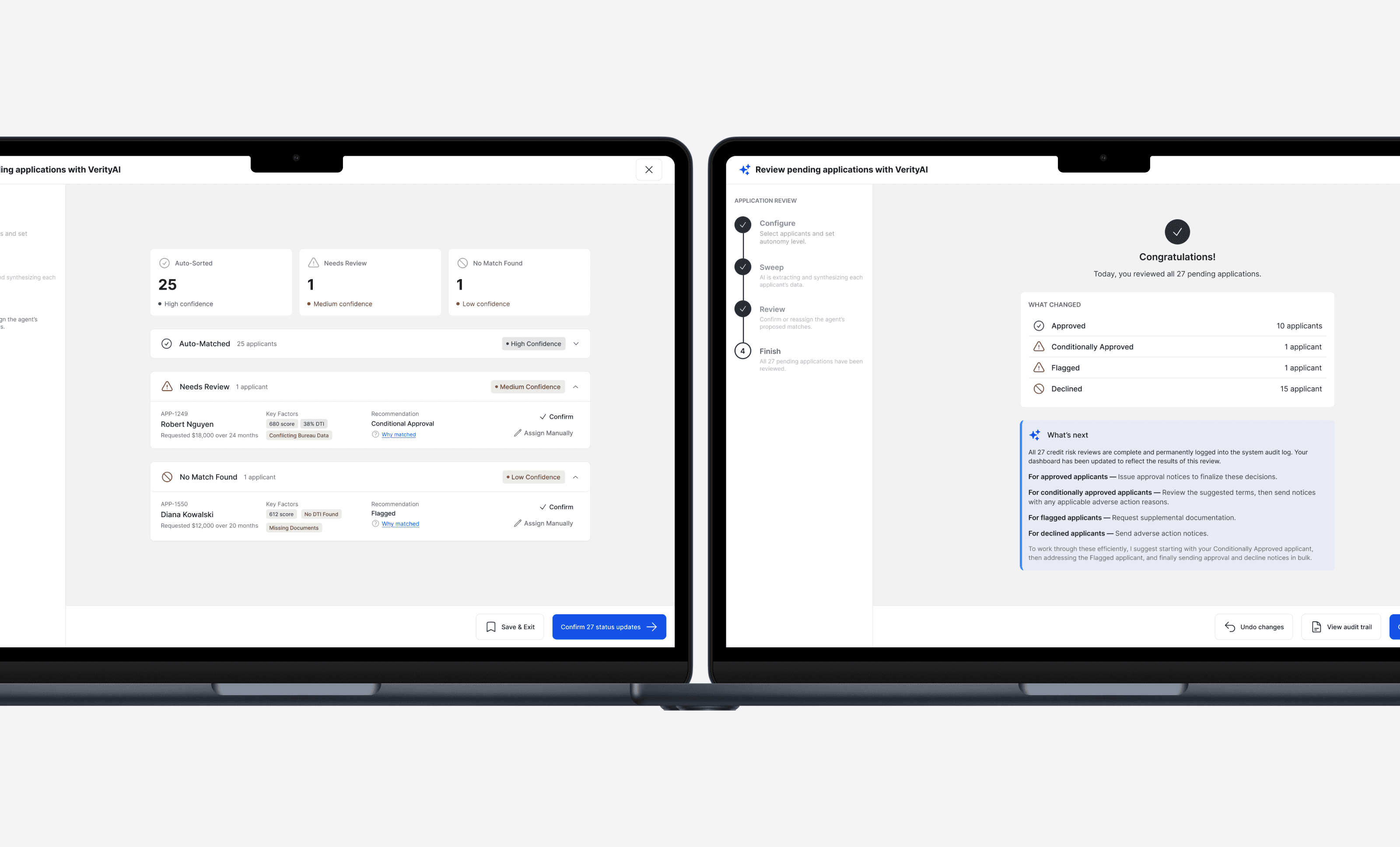
Verity explores how Lexington Law’s expertise in consumer credit could extend into B2B financial services, particularly lenders who are processing consumer credit applications. This was an early-concept exploration, not a shipped product, with Verity imagined as an AI-assisted tool embedded within a broader underwriting dashboard. Built to help underwriters evaluate applications and make smarter, faster credit decisions, the final designs showcase a four-step workflow built around six agentic patterns, visible trust surfaces, and a formal evaluation plan.
The Challenge
Credit underwriters manage a high volume of loan applications under time pressure, yet any individual case can carry nuance — a cross-bureau data conflict, a borderline debt-to-income ratio — that a blunt automated approve/decline would miss. The design problem was to build an AI underwriting partner that eases the burden of reviewing dense credit files without asking the underwriter to re-verify everything by hand, and without letting the AI make the final call on its own.


02 • Approach
Research + Insights
Research took the form of a competitive audit of AI credit-decisioning products (Zest AI, Scienaptic AI, Candor Technology), paired with a broader look at interaction patterns unique to AI products — cold-start guidance, latency and streaming, uncertainty and sourcing, non-determinism, and the privacy considerations that come with memory and personalization. That work shaped two early decisions: Verity's mode classification as a Collaborator, and an AI-specific pattern checklist that guided every screen built afterward.
Ideation + Iteration
Verity's interaction model went through three distinct phases before landing on its current shape. I initially explored a one-shot “Booster” for generating recommendations in bulk, but realized that this problem required more back-and-forth collaboration. Next, I experimented with a conversational AI chat experience, but found it introduced too much ambiguity for a workflow centered on reviewing multiple cases. Finally, I landed on a guided workflow that could focus the user towards reviewing high quantities of applications while leveraging confidence signals, expandable trace evidence, bulk confirmation, and mandatory individual review before consequential actions.


03 • Validation
Testing + Feedback
The evaluation approach centers on a five-pillar audit alongside a formal eval plan — a scoring rubric, a golden set of input/output pairs spanning an eight-category taxonomy (Normal, Edge, Decline, Ambiguous, Adversarial, Multi-Turn, Out-of-Domain, Malformed), and a defined regression check so future prompt changes are measured against known-good behavior rather than reviewed by feel.


04 • Reflection
Summary & Reflections
This feature showed me that speed and rigor don’t have to be at odds: high-confidence cases can move through bulk fast-confirm in seconds, while cases that need judgment—like a bureau conflict or unverified income—are automatically flagged for human review. AI is rapidly changing the products we build, and there won’t be a single interaction model that works for every AI-powered experience; for this project, finding the right framework meant designing guardrails at both levels, in the AI’s system prompt and in the interface itself. More broadly, the work raised an important question for AI product design: how and when should we give AI more autonomy, and when should we intentionally bring humans back into the loop—especially in highly regulated industries?
14
NEW
screens
8
NEW
DS components
✨
DEV-READY
golden set prompts
Next Steps
As a next step, I’d explore Memory Controls: what Verity remembers from each session, where that information is stored, and how much control users should have over it. In a highly regulated industry, that also raises questions about what should persist beyond a session, what users should be able to view or delete, and how memory should affect future recommendations. The goal would be to make Verity’s memory feel intentional and transparent—not like something happening invisibly in the background.