CreditRepair.com Cancellation Flow
Balancing FTC compliance and retention strategy to ship a dynamic cancellation flow in 8 weeks
Year:
2024
Timeframe:
8 weeeks
Tools:
Figma, Figjam
Category:
Product Design

01 • Overview
Context
CreditRepair.com is a B2C credit repair service under Credit.com, built for a younger audience working to identify and dispute negative items on their credit report. Previously, clients could only cancel their subscription by text, email, or phone — there was no self-serve path. This project introduced online cancellation as a brand-new feature on an existing site.
The Challenge
The biggest driver for this project was the FTC Click-to-Cancel regulation, which required cancellation to be just as easy as signup. That gave us a strict deadline we had to meet. While compliance was the priority, stakeholders were also worried about churn, so the real challenge was building retention opportunities into a flow that still had to stay simple and transparent for the user.
How might we enable users to cancel online while minimizing churn?

02 • Approach
Research + Insights
I worked with my Customer Experience team to review 19 recent cancellation cases, segmenting clients into four groups based on tenure and outcomes — success, struggling, sticky, and new — each pointing to a different retention approach. I also audited competitor cancellation flows, which surfaced ideas like payment pauses, personalized progress reports, and efficacy-based timeline education.
Ideation + Iteration
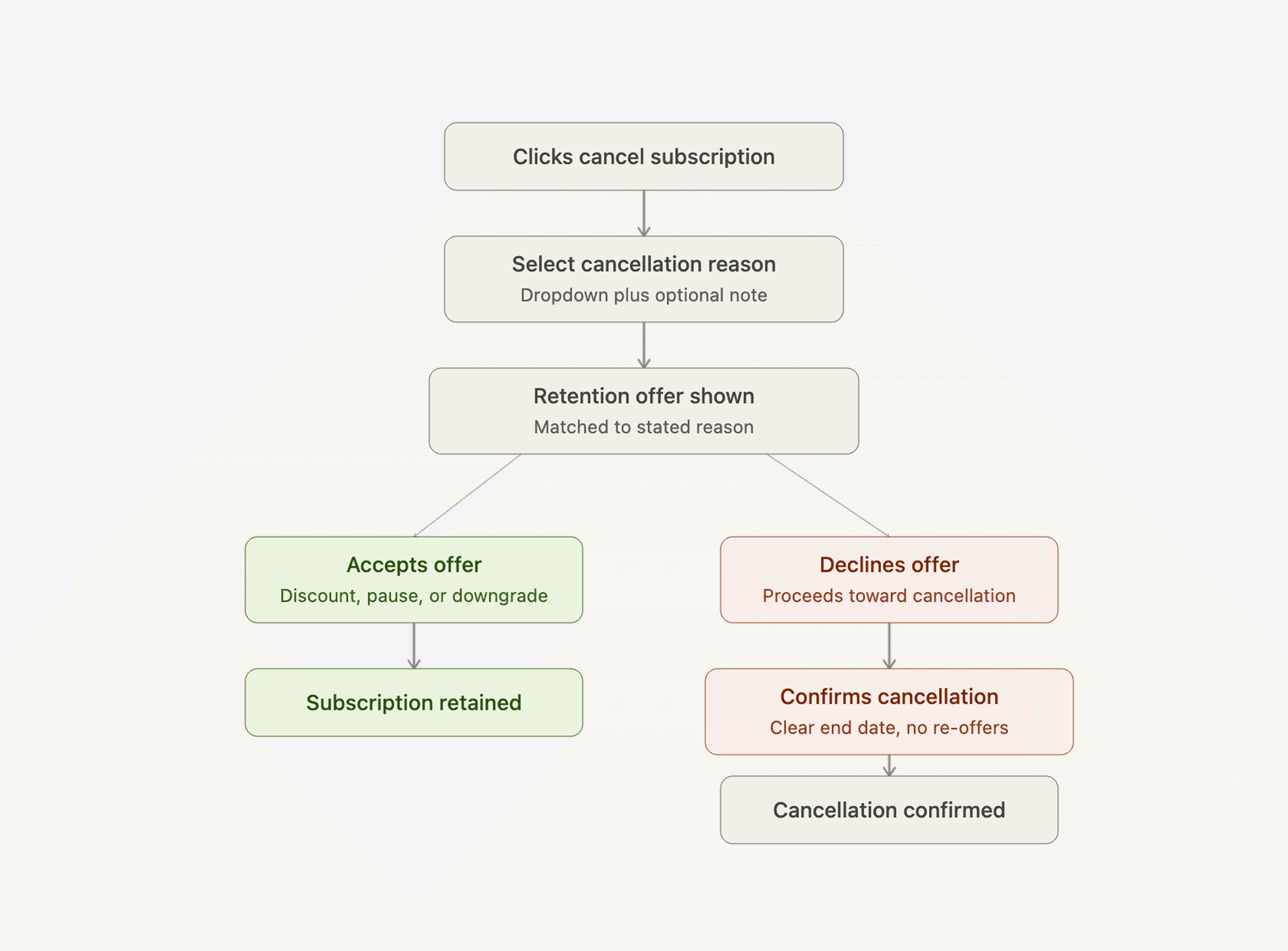
With my PM, I mapped the target user flow to align the team on scope, keeping it updated as a single source of truth through iteration and handoff. Two ideas from the competitive research were ultimately tabled: a real-time progress reminder, which needed backend investment we didn't have time for, and a timeline/efficacy chart, which needed a legal resurvey and ran into CROA's restrictions on implying guaranteed outcomes.


03 • Validation
Testing + Feedback
Given the compressed timeline, I tested in-house with 6 people spanning Customer Experience, Accounting, Engineering, and Product rather than running a full external study — a tradeoff I made deliberately to protect the launch date without skipping validation altogether. That testing wasn't just a formality; it surfaced two microcopy gaps that shaped the final flow. On the discount offer screen, users wanted clarity on what they'd actually be paying if they accepted the retention offer, not just the discounted rate — so I added the resulting price alongside the percentage off. On the confirmation screen, users wanted to know exactly when their final payment would be billed before their subscription ended, which I surfaced explicitly rather than leaving users to infer it from their original billing date. Both changes were small in scope but mattered for a compliance-sensitive flow where transparency about billing is the whole point.


04 • Reflection
Key Outcomes
What we ultimately shipped let the product team capture cancellation feedback, surface a dynamic retention offer, and meet FTC standards within a single flow. Despite the tight timeline and the ideas we had to table along the way, the flow delivered on both halves of the original challenge — compliant and retention-minded. Together, the completion-time and retention numbers show the flow didn't force a tradeoff between compliance and business goals — meeting the deadline didn't mean giving up on retention, and building in retention didn't compromise the simplicity regulators required.
89%
COMPLETED
in under 2 min
12%
ACCEPTED
retention offer
✨
CAPTURED
product feedback for improvements
Next Steps
Both concepts we tabled were cut for timeline reasons, not because they were the wrong direction — so they define the roadmap rather than a list of regrets. The progress-reminder screen needs backend investment before it's viable: new APIs surfacing letters sent and upcoming scheduled work, so the data can update in real time and be personalized to each individual user. The efficacy chart needs a different kind of investment first — Legal's requested resurvey of client outcomes — before Design can revisit how (or whether) that data gets shown in a way that builds trust without implying a guaranteed result. In conclusion, this initiative proves a principle I bring to every high-stakes feature: compliance and retention aren't competing goals — they're a design problem, and treating them as one produced a better answer than solving for either alone.


